
Episode Summary
Freight classification is undergoing its biggest shift in years and it’s coming fast. With July 19 around the corner, understanding upcoming NMFC classification changes and how they will impact your shipments is key.
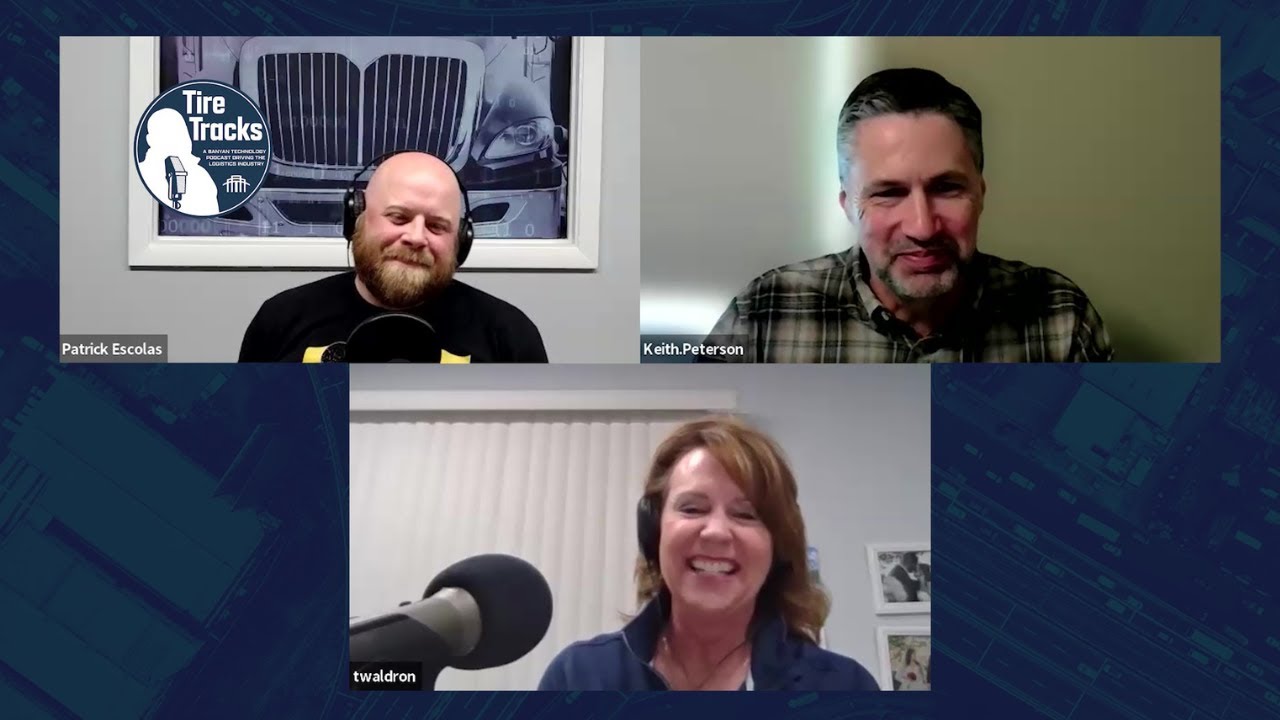
In Episode 52 of Banyan Technology’s Tire Tracks® podcast, Keith Peterson, Director of Operations at NMFTA, and Teresa Waldron, Director of Client Experience at Banyan Technology, break down the NMFC classification changes and discuss how palletization, tech and collaboration are shaping the future of LTL.
Peterson advises that Shippers and 3PLs use this change as an opportunity to revisit how they package freight, especially how dimensions are measured and whether handling units are optimized for efficiency and damage reduction
“Knowing your freight’s density and dimensions is more important than ever,” Peterson said. “This change makes it easier and more accurate to classify shipments, but it requires everyone to level up how they operate.”
Peterson shares that the overhaul to the NMFC was driven by a need to better reflect how freight looks today. He explains that before this change, only about 100 items had moved to full-density classification over several years, but the new docket will affect thousands of items in one coordinated effort.
NMFC Classification Changes Episode Key Points
- Keith’s “born-in” logistics journey and Teresa’s LTL career path.
- What it’s like managing NMFTA’s classifications.
- Why density became the primary classification factor.
- Insight into how freight class will change in July.
- Examples of items with drastic classification changes.
- Simplifying classification through palletization.
- Banyan’s tech updates to support the NMFC classification changes.
- The essential role of technology in NMFTA’s updates.
- Why the timing is right for this overhaul.
- Reasons why more freight is being palletized today.
- How reclassification impacts product catalogs.
- Whether or not reclassifications will reduce rating disputes.
- Ways that Banyan stays ahead with education and tools.
- Final preparation tips for Shippers, 3PLs and Carriers.
“What carriers really want to charge for is the space on their trailer. That’s [the reason for] the push to density.” — Keith Peterson [0:19:58]
“Be aware that, if you have a lot of classes that need to be updated and if you utilize our product catalog, those changes are going to have to be updated in your catalog as well.” — Teresa Waldron [0:25:19]
“Get to know your shipment profile. What does your freight look like going out of the dock? This could be a good chance to relook at your packaging. – Can it be more dense and can you get less damage as a result?” — Keith Peterson [0:34:13]
Learn how you can prepare for the upcoming NMFC classification changes. Click above to view Tire Tracks episode 52.
Read our full coverage of the NMFC classification changes and what they mean for your business.
Subscribe to Tire Tracks on your preferred podcast app to receive notifications of new episodes released twice each month.
Transcript
Hi, everybody. It's Patrick Escolas with another Banyan Technology Tire Tracks podcast. I have a special treat. It's not just me and one other person. I got me and two other people. Today, I have Keith Peterson from the NMFTA, and I have Teresa Waldron from Banyan Technologies. Thank you both for being here.
Thank you.
Thanks for having me.
Yeah, or being the slowest one to get out of the way when they had volunteers go. But I'll start with the non-Banyan because, quite honestly, I know Teresa. But Keith, how did you come into logistics? Which I always ask because everybody's got kind of a weird, funky story of how they get in there, whether they're born in or founded in life. And what is your position at the NMFTA? And why are we talking today? Give us a little intro. Who's Keith? Who is Keith?
I'm Keith Peterson. And how did I come into logistics? I'm probably more in the born-in category itself.
Some of my very earliest memories are inside a truck with my father. And then I eventually worked for him as I was going to school.
And then once I was done with school, I asked what was next, and he actually put me out on the road for a year. I drove across the road for a year. Then worked through operations at a couple of different companies and worked for Qualcomm selling telecommunications to trucking companies. And now I am the director of operations at NMFTA. I have direct responsibility for the classifications team, as well as the digital councils. And you guys are actually a part of the digital councils as well here.
No. That's awesome because I love the born-in. And it's funny, I've heard people that have basically grew up on the side of the warehouse or the distribution, Pat, and where it's kind of in the truck. And I'll go back, I'll ask a few questions. But I don't want to be rude to Teresa here. Teresa, what do you do at Banyan? And how do you get into logistics?
Well, what I do at Banyan? I've been here at Banyan. Actually, you know what? I just hit my anniversary today. Isn't that crazy? I just realized today is May 1st.
There you go.
Yeah, happy work anniversary to me today.
How many years is that?
Four years.
All right. Very nice.
I'm the director of client experience. I've got our customer solutions team as well as our onboarding and implementation group under my umbrella. Prior to that, I spent 26 years with the National LTL Carrier. Started in customer service and really worked my way through a gamut of roles, from quality, to insight sales, to customer service management. And then my last 10 years, probably about six to seven years, I was actually an account manager on our corporate 3PL verticals. A wide variety of roles and functions in the LTL industry.
And I really enjoyed bringing that knowledge here at Banyan and been able to share my wealth of knowledge with logistics. And I think here a lot of people are like, "What's that verbiage? What's that lingo? What's is NMFC?"
I was going to say, we weren't recording when I first started, but you were definitely the one that, when I got through all of this alphabet soup, I'm like, "Yeah, aha." And I get off a call and be like, "I need you to explain what the heck was just talked about." And within that, and I don't know if I missed it, but what got you into logistics? Were you born in or did you find it along the way?
I wouldn't say I was really born in it. But however, my dad did drive trucks. He didn't start that in his life, but he started as a state patrolman, but got out of that and then went to – he drove for Walmart. That's where my father retired from. I guess it is in the blood. It is in the blood.
Yeah. No. There you go. No, that's awesome. We got two legacies, heirs to the logistic fortune. No. But Keith, back to you for a second. You mentioned that you're over the classifications part of the organization. And I imagine that puts you in a very hot seat with a lot of people that know what the NMFTA is and whether either curse your name or go, "Dang that, Keith." What is that like overseeing something that touches every shipment and everything that moves? What's that like from your perspective and what kind of thought goes into that whole process?
What's it like? You know what, I choose to look at it from the positive side. There's never a lack of opinions for you to kind of build off of and ideas for what to do next here. It's actually a lot of fun. It's really different than anything else I've done in my career, and I find it to be a lot of fun to kind of dig into how this can be done. The classification process is, I always think of the old Saturday morning cartoon and how a bill becomes a law, a little bit, right?
Yes. Yeah.
We release a docket, we get feedback on it, and then we have a final meeting to kind of decide what it's going to be finally here, and then it eventually goes into effect. In July, in this case, right? It's a little bit like that. But even up to the release of the docket, building the proposals, there's discussing what's going to be on it and why. And it can be quite a process. I remember one of the first discussions I was a part of was they were discussing concert logo t-shirts. Now, are those clothing or advertising? It's like the thing.
Yeah. Is a tomato a fruit or a vegetable? And can we have pizza at school still? Yeah, no, exactly. There's probably a few meetings that are really excited and a few meetings where you're like, "Are we really talking about this? It's been 20 minutes already. And I've heard that word too many times." Yeah.
Yeah, it really can be at times. But on the other side, there's a lot of science to it, looking at density numbers and everything as well. And if there's handling, stowability, or liability issues. It's actually a lot of fun. And my team has taught me a lot in the past year and a half since I got here. Yeah.
Yeah. And within that, I think one of the reasons we're talking and we talk about classifications is we've got some changes coming. And like you said, they're going into effect in July. Why don't you, for anyone that may not be in the industry, because I'm sure most industry players know this is coming, or if they don't, should really pay attention. But what's coming along the pipe here? What's going into effect in July?
Sure, sure. One thing that's been going on for a long time with us at the NMFTA is we made density the primary characteristic when we look at freight.
And what did that shift from, and when did density become the primary focus?
Probably about three, four years ago, they started moving items to what they call full density scale, meaning here's an item with no handling, stowability, or liability issues. You think of boxes on a pallet, right? Probably 80% to 90% of the freight that goes across LTL. And instead of having just certain classes on it, sometimes they'd be single or modified density scales. We just started saying, "Hey, get the dimensions, get the weight, so you can get a density off of it and class it appropriately from there, according to an 11 subscale."
The thought is a simplification of the old way?
It is.
Okay. It's both a simplification and being able to class according to what the freight actually looks like. And the simplification part really comes from freight changes over time. And instead of having to re-look at it and do a whole another search project and say, "It got lighter, so now it's less dense," for instance. Or maybe it got heavier. Now it's more dense. Instead, here it is, it's just on a full density scale. It can change over time. You just need the dimensions and the weight to get a class, and you can get it right from there, from your carrier, basically.
Okay. And so, with this change, I mean, how drastic is it? If I've been using class 77.5 my whole life, or we'll stick one without a 0.5. 125. What does that change? What should I be doing differently? Or it's intuitive because you've been doing the work and now we're just skipping a step.
It can be drastic. Keep in mind, this probably affects several thousand item numbers within the book itself here. And even though we've been doing this for four years, we had about 100 items that had actually moved to full density. It was taking a long time to process. We actually changed around how we're doing this in order to allow to get a lot of items there at once in this docket. And we've been working on it for the past year.
As a shipper, if I'm used to having 77.5, it is likely like a modified or single class density item, instead of just saying, "Here's the item number and I know it's going to be class this," shippers are going to have to get used to actually getting their dimensions and weights, actually, and learning what their actual shipment profile is for that rate as it's leaving their dock. It could be a big change. And that density can change quite a bit. I mean, could go lower. More favorable freight. Or it could go higher as well.
It depends. And one thing you mentioned there that I don't think I really ever thought of, you're considering almost everything that can move in an LTL truck when you're making these changes. It's not like, "Man, we thought of the top 10 or the top 100." Like you said, there's thousands of different things.
Yeah.
Yeah. And so you said some might not be as drastic, some are. If it can, where might be the most drastic change? What's something of some of those items that was kind of your on the red list of, "Oh, goodness. This is going to be way different than it was before?"
Off the top of my head, and I'm just going to be somewhat general here, is the –
Yeah. Please be specific, or I know nothing. Yeah.
The current 11 subscale only went to a class 60. And there's two classes below that. There are 50 and 55. And for those you think very heavy, very dense freight. And that freight sitting on a pallet is very favorable freight. It really is. It's easy to move. We added on 50 and 55, and that'll become effective in July.
I think of a pallet of boxes of nuts and bolts or maybe even a crate of them, right? Whereas possibly it was single class before, and it would likely be either 50 or 55. Now, if it's lighter, maybe they change the materials or something like that, right? It could be a lower density. And then as a result, a higher class. I was getting them backwards.
Gotcha.
There could be some real changes, but adding in those lower densities allowed us to move even more items to full-scale density.
Okay. It's almost like a set of just chocolate and vanilla. We now have the twist, or we have two-thirds chocolate, one-third vanilla. There's more options because there's more things moving today than probably when the class was set in the first place or a variation.
And more of it moves by pallets now, right? A lot of this kind of stems from – we didn't touch anything that has handling, stowability, or liability issues. Those are researched. The density is researched and they're classed appropriately. You're still going to see items that have modified or single class density here. But as many of the items as possible, we're condensing them, especially the generic headings, and that's another big part of the simplification process, and making them full density.
Okay. Thank you for that. And just so Teresa gets a chance here and Keith, you mentioned that Banyan is on that council that kind of puts some input probably in a decision like this as well from a technology perspective. Teresa, what involvement did you have within this as a Banyan member or even Banyan as a whole with that input?
Sure. Just from a technology standpoint, we're preparing for the July change as well. A lot of our clients are asking a lot of questions. One thing that we are getting ready to do here is – well, it's in the works, is the API update to class it to the IT, to the API, just to ensure that we're doing everything we can, that we're staying up with the regulations and the updated changes for our client. They want to make sure they're rating accurately as well.
Also, Keith, you hit on now having the 13 classes in that density structure. We offer a class estimator and a density estimator in our TMS. Obviously, we have to make those changes as well. We've done that research. Use a lot of your information from your website and the docket as well to make sure that we're updating our system accurately. I think just the sharing of information, and the knowledge, and the understanding of why the changes are happening, when they're happening, just to be able to speak intelligently to our clients and what we're doing here to make to make sure that we're going to have real time accuracy on our platform when these changes take place as well.
No. Great stuff. And one of the things that I laughed and smiled there kind of to myself is the density and the class calculator which are so inherently needed for somebody like me who has come into the industry out of nowhere, and they're like, "Yeah, here's the classes. Which class?" I'm like, "Do I pick one? Do I have a favorite number? How do I get there?"
Sure.
And I think, Teresa, you had a fun slideshow the one time where you're like, "Here are the things that would be in that class. One is gold dust." And I don't exactly remember half of the others, but I sure know what class gold dust is, which is nothing I would ever actually have to move. I think antlers was one that you're like – and I'm like, "This is awesome. I don't know when I'll ever use this," but it is stuck there in the brain.
Ping-pong balls and nuts and bolts, those are the 500 to 50. Yeah.
I know.
But as Keith said, that's going to change a little bit. Materials and the way things are made and packaged, and that is going to change a little bit of that.
No. And that makes sense. And I think that not all change is inherently bad, but all change is a little bit difficult or takes some time to get used to. And as we're talking both from the logistics, this association that puts this out, and technology, Keith, how important is technology in the consideration of a change like this and/or how to roll that out? What does that look like? Because historically, and a lot of even who I talked to about, AI and the different technology from a TMS perspective, is that logistics is still kind of that redheaded stepchild. We get the technology after everybody else has figured it out. They're going to space, and we're still kind of sharpening the sword. And obviously, it's not that bad. And there's a lot of different variations where we have some more cutting-edge logistics firms, carriers, and shippers, but we still have those that are just picking up the phone and scribbling it in with a pen and paper.
Mm-hmm. It's vitally important. You were talking about the updates to your site that you're doing, and that's really across the board. It's not just TMSs, it's the carriers themselves, anybody that as a rating engine as well here. And that kind of brings up the other piece that we're working on, because, apparently, making these big changes aren't enough for us here at NMFTA. We're also doing a big refresh of class IT or class it, right? I still can't figure out which one it is.
Yeah. We call it class it. If it's wrong, I feel really bad, but that's probably what I'll go to.
No. That is right. Makes sense. And on July 15th, just four days before, we're releasing classic plus, and it includes updated APIs. Teresa, in your case, you guys are probably already looking at them. In fact, pretty soon we'll open up our sandbox so you can start testing against them and everything.
Yes. Yes, we're ready. We're ready.
Yeah. And that makes it so you can just get that information that much quicker and in a more secure way. And I think the other big piece of this is we started talking about this like a year ago because we knew the size of these changes. And I really wanted to just kind of open the doors on what we're doing to make sure everybody was ready for this. We put out lists about what was in scope up until the docket was released, and you can see it all. And even our get classification, the lookup tool that we just released two weeks ago now, just trying to get as much information out there as possible so people can be ready for this here. Yeah.
Yeah. And we talked about kind of what the change is from, it's giving more options and trying to simplify. But what was the true driving factor and that these changes need to happen, and they need to happen now. What made it so now is the time? And maybe it was a year ago, and now we're just getting to it. But what does it look like from a timing and what's the real push?
The real push, what it's been all along, is to update the NMFC to how freight looks today.
Okay.
And like I said, it has changed so much over the years to now so much of it is just on a pallet, and it's boxes on a pallet or materials on a pallet is really the better way to put it. Maybe crated, right? But still, it easily moves across the dock and gets on and off trailers very easily. It's to update the NMFC to what it looks like today. And keeping in mind that what carriers really want to charge for is the space on their trailer. And so that's the push to density.
Now, as far as the push to kind of get it going a little bit quicker here, when I started a year and a half ago, that was really my charter, to go in and figure out how to do this faster, basically. And it wasn't just me doing it. I got the team on board with it. We kind of changed around, at least for this docket, how we were looking at it. We took the book as it was written today and said, "Do we see any handling, stowability, or liability issues? No? Okay, let's condense it down if we're looking at a generic heading and with the full-scale density."
And we kind of pushed to do it that way because we knew we had a public – we had time after the docket was released to get feedback so people can tell us if we're wrong about something, right? And it can always change going forward. We took it as a chance to really make a lot of changes at once and then start – and there's still more to do. There's still more research to do and everything. But going forward, we feel like we're in a good place for this. Kind of gotten over that big hurdle.
Right. And it sounds like you guys, like you said, there was a lot of changes all at once. And did you ever feel like you had painted a target on your back? Because I know the logistics industry, and nobody is afraid to tell you their opinion, no matter what it's on. What kind of feedback did you get? And was it like, "Hey, this is overwhelmingly." People are, "This is great, or this is a change, and I don't want it? Or if you're doing this, also change that." What did the feedback look like overall? And how much did you use it to develop what we're now rolling out in July?
I'd say the majority of the feedback was very positive about this.
Okay. Awesome.
It's something that makes sense when you look at freight as it is today, and allows people, after the adjustment period, to figure out what their class is that much easier. It was pretty located to go in, find a certain item number, and sometimes it can differ if it's aluminum or steel. There's all kinds of things, right? Now you can just go and search, find one item number, and that scale or class is uniform throughout a lot of these items, so it's just known. I would say overall, the majority of the feedback has been very positive.
Now, there's a lot of people in the logistics industry, a lot of opinions out there. And I heard a lot of opinions as well, but that also tells me that it needed to be changed as well.
I would agree.
And it's something. The beautiful thing about the NMFC is it can be changed more going forward. We can continue to change. This isn't a one-time thing, right? Now, the size and the stock, it is likely a one-time thing. I think my team would kill me if I tried anything different. But we can continue to adjust it in order to, "Okay, maybe this has changed. Let's adjust this a little bit," including the rules in there as well.
And Teresa, help me out here. Keith had mentioned something about more items are being palletized now than they were before. And I'll go back to your carrier experience, even with the 3PL. What is the reason for that, or is it just the way the industry is moving, or is it something within cost, or it's easier on the shipper? And as someone who didn't always get all this palletization, how is that better or worse from a carrier perspective?
I think you probably touched on a couple of the reasons, Patrick. And I've been out of the industry for a couple of years. But my opinion in that would be the handling, the carriers needs. We had capacity there for a couple of years after COVID, but less damage, easier handling, cost effectiveness across the board. You talk about density. Just even speaking with some of our clients, density doesn't lie. The dimensions are the dimensions. And so it makes it easier with those classifications instead. Keith, you got to go in.
I remember the big, thick book, the NMFC book way, way back in the day. Is it knocked down? Is it set up? Is it in a crate or is it on a pallet? Those were all the things that you had to pick from. It makes classification a little easier. The hard part of going through so many right now is, at Banyan, a lot of our clients use a product catalog. It's kind of like they can start to type in a skew or the product. They are going to have to make those updates in their product catalog with these NMFC changes. Our clients manage their own product catalog. We don't manage that for them.
We actually have a team here, though, that will help you when those changes are – if you need assistance, but that is something that we are putting out there. Be aware that if you have a lot of classes that need to be updated, and if you utilize our product catalog, that those changes are going to have to be updated in your catalog as well.
Yeah, and it makes sense that on the shipper or whoever's using it side would do it because you don't want me guessing what this should go in and then finding out. But you touched on something, and maybe Keith will have an answer on this one. In the past, maybe six, eight months, maybe even a year, we've heard a lot about you get a quote, you get something shipped and, all of a sudden, you get re-classed or you've classed differently. Will these changes kind of slow that down, stymie, or is that more on the carrier and the communication and not really the actual amount of different classifications or how it's classified in the first place?
All right, so as I mentioned before, we've talked about these changes for a long time now. And I've personally have had, I don't know, how many calls with large shippers as well, as well as different organizations. We've tried to get the word out to get them prepared, and a lot of them really have been.
There's definitely going to be an adjustment period here as well. And what I've heard as I've talked to carriers is it's kind of all over the board. There have been some that have said the adjustments periods right now, right? You need to learn this. But what I think is good is the carriers are also going out and talking to their customers about these changes. And I'm even hearing more and more about shippers talking to the barriers about the changes as well, "Hey, when is this going to change?" And I think what's really nice as well is the 3PL community has really gotten behind the changes, and that helps immensely. Very thankful to them for that.
And anything to add on that, Teresa?
No, I think Keith's spot on. I couldn't disagree with any of that.
I can see. And it makes sense from a logic perspective that something in the logistics industry where everything is relationship-based, that these communications that are happening are – that long time carrier to the shipper, "Hey, Jim, what's this going to change?" And that makes a lot of sense. And I also like the call out that right now is the transition period. By July 1st, if I'm a carrier or a 3PL, I want to be ready to rock. I don't want to be looking like I'm just learning it for the first time.
And also, just while I'm talking and pretend if anyone cares, that makes a lot of sense from the 3PL perspective that not that classes weren't universal between carriers before, but now it sounds like we're pushing to do an even better job of standardizing how we classify this freight. Within that, is there anything within this docket, in this reclassification, where you didn't go as far as you wanted to and maybe held it here? Obviously, the next docket won't have as many things, but was there a place that you wanted to go and this is a compromise? Or was this kind of the picture you wanted, and now you basically have it?
Most dockets usually have about 15 proposals on them. This one had 99, okay? It definitely won't be as large. But there were some things that we know still need to be done that we're going to continue to work on here as well. It was just a matter of timing. I always try to tell people that there was no report for us to go out and say which items don't have handling, stowability, and liability. It was always kind of in the notes.
We actually had to create a spreadsheet by hand in order to do an analysis. It was quite the process to get to this point. But now that we are, we're ready to keep moving forward with items. And there were some generic headings that we would have liked to get to. We just weren't able to get to on this one. More work to be done. We figured it was about a two to three-year process, honestly, of really working our way through these things. And honestly, there's some rules that likely need to be updated as well within the NMFC, too, here. Yeah.
Okay. No. And that makes sense. It's just constantly growing. And this gets me back to Teresa on this kind of update, and upgrade, and evolve with it. What should a TMS and, specifically, what's Banyan doing to stay on that front line? Because if we kept doing things the way when Banyan was created, we probably wouldn't have the value to a logistics industry that it's always ever changing, but it feels in the past five years, each week is kind of a new game.
Sure, absolutely. I think just from a business perspective, we need to do our due diligence that we are staying educated, staying on top of the changes, keeping our clients informed. We just put out – promoting your free product, Keith. Commend you on that tool. I played around with it myself a little bit. Love that you can do the important, have the export. You're gonna have some folks that are going to have a lot of NMFC changes. And I think that was a very nice tool.
Just very much staying educated and letting our clients know that we're making changes to the Banyan tools to keep up with that. We have to be able to provide a TMS that's accurate and it's a rating engine. And our clients, they lean on us to be able to use an accurate tool and provide accurate information.
And within that, that makes a sense of just from across the board and just how to be the best partner for your customers there. What should we talk about if you've got items in your product library, you're going to want to update that to meet the new classifications of density base? Is there anything else that someone who's a Banyan or even a TMS customer in general should be doing to prepare for these changes?
From my perspective and a little bit about what we've been talking, educating yourself and educating your team. From my team here, just making sure our client solutions team is educated. What the changes are? Being able to help our clients when they call in. What should I do with my product catalog? I don't even know what changes are happening, letting them know that we are updating our system and our tools so that clients aren't panicking if they're calling in. And then just preparing yourself. Knowing the dates that these are changing. Talking to your carriers if you're a shipper. When should I be using the new number on my bill of lading? Can I use it a week before? Do I get a grace period a week after? I think it's just all about really asking those questions that you're concerned about. Depending – are a 3PL? A shipper? What my tools are? What's my rating engine? My TMS. Just really staying educated and on top of what's going on.
Yeah. No. And Keith, is there anything – I know we've talked about a bunch here, but is there anything additional that carrier, 3PL, shipper should be doing to prepare themselves other than just kind of this education and awareness? And Teresa mentioned this free tool. Talk to me about how they can utilize that and where they would find that as well.
Sure. Sure. I'll start with the free tool.
Everybody loves free.
www.getclassification.com. We have links to it all over our websites actually.
I'm sure when this comes out, we'll have a link somewhere below to that that too. Yeah.
Yes. Please share it.
We do. Yes.
Yeah. That's great. It's a tool where you do have to register. But believe me, it's free. You don't have to put in your credit card or anything. We just want to know who's using it. But you can put in either a single, you can put in multiple item numbers. Or as Teresa said, a whole spreadsheet as well, and it'll spit back at you the new item number if there is one, as well as what's happening to that item. It'll also tell you if the item is not affected by 2025-1. The key is that you do have to search by item number. It's not meant to replace class it here. You do have to search by the actual item number.
And if I were to tell anybody, especially shippers, one thing I heard from Pitt Ohio in one of their podcasts that I thought was key is get to know your shipment profile. And what does your freight look like going out the dock? And this could be a really good chance to relook at your packaging. Can it be more dense, right? Can it be more dense and can you get less damage as a result? This could be a really good chance to take a look at that instead of just thinking – I don't want to oversimplify it, but some boxes that are shrink-wrapped on a pallet, right? Is it taking up the whole palette? Because people have to realize the dimensions get taken from the edge of the palette, not just the boxes that are on there, right? Is everything right size? I think it's like a key point to see, is your handling unit optimized for shipping, basically?
Okay. No. And that makes a lot of sense. As we're getting to a bit of a wrap up here, is there anything, whether it's with these changes or within the NMFTA, that you'd like to – and I always like to try to do this, is a message. Use this platform. Whether it's from Keith Peterson, the person, Keith Peterson, the director of operations of the NMFTA, or just somebody speaking on logistics in general. What is your message to any shippers, 3PLs, or carriers that are listening right now? It can be on this topic or it can be on anything, just something that you feel you want to get out there?
The whole point of these changes is to make classification easier and simpler to use for everybody, even somebody coming brand new into the logistics business. It's all about Lensing down the number of items and making the class levels uniform across those items that especially have no handling, stowability, or liability issues. That's the whole point to make it that much easier for new people or even the people currently in it that maybe never realized about it, anything about it, that much easier to pick up and start working with.
It is so important for LTL carriers to know the dimensions and the weight that they're planning to pick up. If you really think about it, how else can they plan? Right? If they don't know what's coming. That's what we're working towards, and that's where we're going to get to.
That's awesome. And, Teresa, kind of same question, same opportunity for you, whether it's from Teresa Waldron or Teresa Waldron director of client success and experience from Banyan. What's your message? What's your thought?
Just knowing that here at Banyan, we're here to help, we're here to answer questions. The team is educated. We're ready. We're prepared. We've got our changes. They're in our upcoming sprints. And just know that if you have questions, reach out. We're here. We're ready to help.
Well, that's awesome. And that's easy to recap. You heard it, guys, from Keith at NMFTA. They're making these changes for you, no matter what side of the shipment you're within LTL . And Banyan is here to help, whether you're a long-time customer, new client, or are just looking to get into the TMS space. Because as Keith said, you've got new people that don't have that 30 years of freight, or you're scaling, or any of the other reasons you're going to get into information technology within that logistics space.
But yeah, Keith, thank you so much for the time today. I really appreciate it. I've been hearing about these changes for a while coming, but it's nice to hear them concrete and ready for the July 1st rollout.
We're all set. July 19. I'm going to correct you.
July 19. There we go. There we go.
July 19th.
You guys get July 4th. But when you get back from the cookout, it's coming. No.
There you go.
That's perfect. And Teresa, absolutely. Thank you. And everybody that's watch –
Thank you.
Yeah. Everybody that's watching, thanks for listening, watching, subscribing to the Banyan Technology Tire Tracks podcast. I'm of course, Patrick Escolas with the best hair in the business. And we'll see you with the next one. Thanks, everybody.