
Episode Summary
Warehouse operations have come a long way from clipboards and shouting down aisles. As order volumes grow and e-commerce expectations rise, having the right systems in place is more critical than ever. Enter WMS integration.
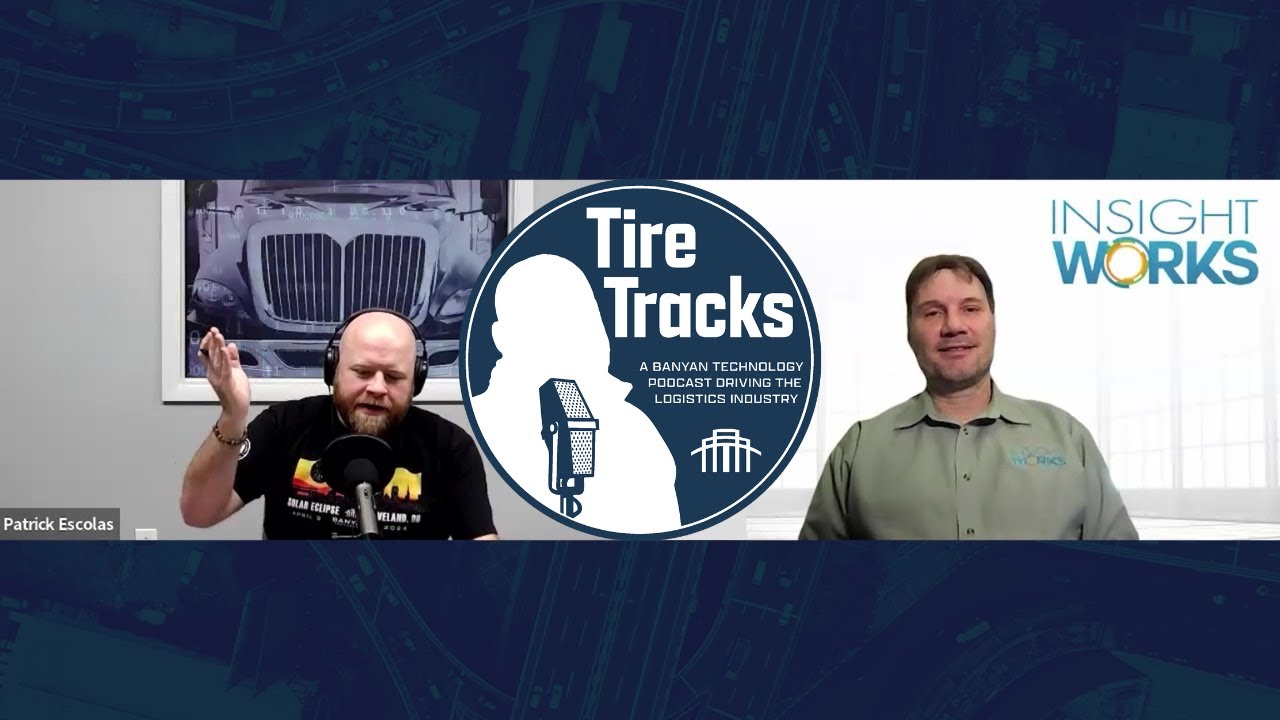
In episode 51 of Banyan Technology’s Tire Tracks® podcast, Mark Hamblin, President at DMS Companies – parent company of Insight Works, joins Patrick Escolas to explore the growing importance of Warehouse Management Systems (WMS). From real-time inventory visibility to TMS and ERP integrations they cover what Shippers need to know to stay competitive.
He also dives into the power of connecting WMS, TMS and ERP for seamless shipping. With integrated systems Shippers gain the accuracy, speed and visibility needed to meet customer expectations and cut down on manual rework.
“The WMS is really the operational side where I’m dealing with picking and moving inventory. The ERP looks after the cost side. When it’s all built into the same system or easily integrated, that’s when you really start to gain efficiency,” Hamblin said. “We’re not going to go out there and manage the TMS. We’re going to partner with [Banyan] to do those things. You want to leverage best-of-breed platforms that do their job very well.”
Hamblin explains how automation, cloud-based tools and AI are shaping the future of warehouse operations and why now is the time to consider a scalable solution.
WMS Integration Episode Key Points
- Welcome Mark Hamblin, President of DMS Companies.
- How to know that it’s time to invest in a WMS.
- Some of the uses for data that can be gained from a WMS.
- The difference between a WMS and an ERP.
- Other systems that a WMS ecosystem can consist of to enhance functionality.
- How this kind of system bridges the gap between the digital and physical worlds.
- Pros and cons of cloud-based versus on-prem systems.
- How the cloud forces users into better security practices.
- Understanding the cost-benefit of a WMS.
“WMS has been around ever since there have been warehouses because in its simplest form, WMS is a Warehouse Management System.” — Mark Hamblin [0:01:49]
“It’s been a long road but we’re definitely at that point where connecting up disparate systems is pretty simple.” — Mark Hamblin [0:17:14]
“There’s very little reason to not go with an automated data collection or a WMS.” — Mark Hamblin [0:24:20]
Explore how WMS integrated with a strong TMS helps streamline operations, reduce errors and deliver a smoother shipping experience from dock to doorstep. Click above to view Tire Tracks episode 51.
Subscribe to Tire Tracks on your preferred podcast app to receive notifications of new episodes released twice each month.
Transcript
Hey everybody and welcome to another Banyan Technology’s Tire Tracks Podcast. I'm Patrick Escolas. I'm still bald and it still haunts me. Yeah, I know. I'm here with Mark Hamblin again. He is a glutton for punishment, because he is going to talk to me again on this, about Insight Works and we're going to talk about Insight Works. Mark, how you doing?
I'm good. Thanks. Yourself?
I'm doing really good. You can't tell, but I have shorts on. Now, it is still 50 degrees, but it is a 30-degree increase in temperature. It is basically beach weather right now.
Excellent. Excellent. Yeah. Well, we were down to the minus 40s, minus 50s little while ago. So, same here. I'm not wearing shorts. I am wearing pants though, luckily, for this episode.
Well, you heard it here first. This is a podcast. Pants are on. Mark, not just Insight Works. We’ll talk about is really warehouse management overall. But what I wanted to start with is where did – warehouse management system, I hear it a lot with talking to my customers and clients, but the WMS isn't something that I was hearing about maybe even five years ago, to the extent that it's every other person I'm talking to is, hey, we're looking into this. We just got this. We need to integrate to this. So many of them are WMSs. What is it? Give me first, what is WMS for the layperson? Then, why is this such a big, important topic right now?
Yeah, it's interesting. I mean, WMS has been around for, well, ever since there's been warehouses, because in its simplest form, WMS is a warehouse management system, right? More advance tech, or something using barcode scanners with and all those sorts of things. It's the tool you're using to manage your warehouse. Of course, we tend to think of WMS as something that's got barcode scanners, or RFID, or all these additional things. Some intelligence to it. Like you said, yeah, in the last five, 10 years, the accessibility of those more advanced systems has really improved, right?
You've got roid scanners that are cheap. You don't need to spend hundreds of thousands of dollars to go out there and automate your warehouse. You see a lot of them, the smaller companies now thinking about it, because it is a lot more accessible.
To go through, what has to happen for an organization to realize they need a WMS if they haven't had one in place? Is it you get to a certain point of shipments, or an inventory? What are some key points that determine if I need to get something to organize this, or it's still okay, just a shout to the back?
Yeah. I guess, it depends. It's sort of a subjective thing. But in other words –
Yeah, the answer you give won't be the rule, right? But looking for –
You’re going to follow this.
Yeah. More of what you see.
Yeah. It's really probably a volume thing, or potentially a cost thing. If you're shipping high-value items, you may want more control of them. But it tends to be a volume-oriented thing. If I'm doing a few shipments a day, and I don't have a ton of inventory, I can manage that easily enough on paper. Even a WMS that just generates paper documents, you have to reenter and things isn't necessarily bad. If you're lower volume and not having to deal with a lot of miss picks, if you've got a larger staff, those sorts of things. The challenge is if you're doing things manually, you end up making mistakes, right? Everybody makes mistakes.
I have never made a mistake. I've never made a mistake. I'll take your word on this.
Yeah, you invited me to this, so there's your first mistake. Yeah, really, I mean, it's a numbers game. You say, “Hey, we've got a 5% error rate, or 10%, or whatever that happens to be.” Great. “I'm doing 10 shipments a day that's an negligible amount of error. I’m doing a 1,000 shipments a day, well, okay, now that's starting to cost me some money and I'm –
It’s going to add up.
That's a good thing. That’s going to address those issues, right?
Now, when you're talking about errors is one of the challenges, or that this a WMS could solve, what are some other challenges? You talked about paper. Other than reducing some paper cuts. What are those alarming callouts, that goes, hey not just the volume itself, but even if they're not the main reason you get into WMS, the tertiary benefits, or solutions from that?
Yeah. I guess, when we talk WMS, most people think of, okay, I'm doing barcode scanning. Put the scan guns. I'm going out there and scanning. Really, that's what the WMS solves is that inventory accuracy, right? Everybody's got their physical data, the physical environment and then they've got their virtual data sitting up in their ERP system. Getting those things to match is very important, right? That data is a big competitive advantage if you've got real time and accurate information.
No, and with that, their real time and accurate information, how – obviously, it's more and more important now and we get it more frequently, more easily accessible. I guess, it depends on who might have in the past. What is that data able to be used for? Why is that such a benefit?
Oh, tons of stuff, right? Customer
We'll keep you to – give you your top three. Yeah.
Yeah, really. I mean, it's all about reacting to customer requirements, right? Do you have this in stock? No, I don't. Well, I've got a thousand sitting in receiving. Just nobody's typed in the paperwork into the computer yet. Hey, did this ship yet? I don't know. Let me call you back. That's not a good customer service. We're expecting to get those answers immediately, probably even on a web portal nowadays, right? Those types of things.
Who wants to talk to people anymore, especially the one's younger than me.
Yeah. Really, it's being responsive to customers and vendors, getting that real-time information. Then, it needs to be accurate, right? You don't want to say, “Oh, yeah. We got it in stock. We're going to ship it out in the next hour,” and they go out to pick it and it doesn't exist.
I was just going to say, and with that, along that line, I would imagine e-commerce is probably a big driver for a lot of these pieces, because like you said, it's matching that virtual inventory to the physical inventory that needs to actually go out after somebody clicks the right amount of buttons.
Absolutely. Yeah. That is exactly the primary reason to get into the automated data collection, which is roughly synonymous with WMS, right? Some of the tertiary things you asked about, just improvements in labor utilization. Like, you're going to pick faster, you're going to have less rework in the warehouse because you pick the wrong product, those types of things. Those really add up over time, right? But the big thing is making the mistakes. If I ship the wrong product, that sucks. I don't want to have to ship it back on my dime, re-ship the right product to potentially lose that customer, because you did something wrong, right?
I've talked about it with other guests, that the errors aren't just an issue with the cost of you reshipping, or reproducing, but there's that soft cost of the perception in how your customer felt while not getting what they thought they were getting, when they thought they were getting it. Again, that's hard to quantify within dollars’ value sometimes, but it's just as important. As we're playing this three-letter acronym game with WMS, we also have ERPs out there. I live in a CRM. What’s the difference between a WMS and ERP? Because, well I, as far as the WMS world, TMS, I'm all fine. That's a foreign object, and I might think of it just like I think of an ERP system. Where's there a difference?
Yeah. I mean, quite often the modern ERP systems include some level of WMS as out of the box. Really, one way to look at it is ERP is concerned with dollars, WMS is concerned with quantities. I mean, that's a fine line there, or a solid line between those two things.
It's too late. We've already defined it. It's on Wikipedia. It's what everybody will find when they're researching for their school papers for the rest of time.
The WMS is really the operational side, where I'm dealing with picking these quantities, this product, this and that. The costs don't come into play. The ERP looks after, okay, what did it cost me to get that? What's my labor cost associated with it? A lot of that information, of course, feeds from the WMS, because we're actioning that in the physical world. That's where the line is drawn. The ERP is keeping track of the costs of the inventory, everything else. WMS is keeping track of where it is, how we move it around, how we get it out. Some more of the quantity versus the cost.
Is that common for the – we'll talk to some of your experience for the WMS to be integrated with an ERP, or there's sometimes reasons that it would stand alone?
Yeah, good point. We work primarily in the Microsoft business central world and it's largely integrated. A lot of the WMS functionality is built into the ERP. That's common for a lot of, again, more modern ERPs.
To say, you got Microsoft on the name, so it's got to connect to some of those things.
Yeah. Then, of course, we add our solution on top of that. An external WMS does have advantages in certain situations. Typically, they're, well, actually on, on two extreme ends of the scale. One is you've got a very simple accounting system. You've got QuickBooks, or something like that. But you happen to have a warehouse, you need to manage your parts area, you need to manage – well, you might get an external WMS for that small type of accounting system, where it doesn't have that functionality. Then the other extreme is very large organizations, where what's coming out of the ERP really isn't necessarily best of breed. You need something that's going to be able to handle 100,000 transactions a day, doing a lot more of what you need within that warehouse. It tends to be the larger, higher end type solutions, right? Where were –
Because you're dealing with such a high volume, the ERP, or even the WMS within the ERP might try to do something holistically, but that's going to be a lot of bandwidth and maybe not be beneficial to the operation as a whole?
Yeah. Yeah, exactly. Those standalone WMS solutions, they're not for the faint of heart, they're not cheap, they're not easy to implement and things like that. But for very large warehouses, they might be worth considering, right? You're looking at probably a couple of million bucks to get started, and again, depending on where your –
Yeah. Pocket change. Yeah.
What you need. Yeah. Really, what we're seeing and we focus on the mid-size segment. People are running what's in the ERP system, because it's all integrated, right? Because you need to marry those quantities with those costs, and if it's all built into the same system, that's easy to do. Pretty much all the mid-size ERP solutions will have some level of WMS in them. Then there's people like us that extend that core functionality with what you really need to have in the warehouse to make them work.
Speaking of where you expand that core functionality and have the ability to integrate with a TMS, like Banyan, to get more value out of it, what other pieces does Insight Works both in that expansion that you're talking about, but other systems that it integrates to other than an ERP and a TMS that can make it more effective? Talk to me about what some of these WMS ecosystems look like and what Insight Works is doing to get more out of it.
Yeah. Well, that's, hell, that's a good question.
Yeah. It's 10 sentences. Yeah.
You touched on something important there, right? Like the TMS, working with Banyan. Those are the things where instead of trying – it's like the ERP, building a WMS within it. They're never going to be as good as what a best of breed company, or somebody that's focused on WMS and things like that are going to do. I mean, we manage, we do WMS, we do shipping integration, so packaging and all those sorts of things. But we're not going to go out there and manage the TMS and those sorts of things. We're going to partner with you to do those. There's a lot of that, EDI, TMS, things like that, that we want to leverage those best to breed guys that are out there that can do that job very, very well. We'll focus on more we do very, very well. Then we make it easy to connect up to all these other guys that do what they do very, very well.
Yeah. No, and that makes sense, because we're not going to all of a sudden go assume we know how to make a WMS. Chances are you're not going to jump into the TMS and it's okay to, like you said, have partners that are already the strong person in that field and just latch onto that. Yeah. Otherwise, you're going to overextend. What does that mean from an end product to the customers and the client? When everything's connected and flowing, how much better is that? Or how is that different from if I've got all of these pieces, but they're just living in separate silos and then, you know?
Yeah. It really comes back to bridging that gap between the physical world and virtual world. If you've got a consistent interface, everything's connected through automation. It's just going to be much nicer than having to jump from system to system, right? If I can do my packaging on my hand-on device going to the ERP system, which hosts the WMS, get my shipping rates and schedule pickups and all those sorts of things. Man, that's so much easier than having to go do this and then that data sinks over to the ERP, and then I got to phone up some carriers and go to another place to do that. Having that all integrated and any other modern world, we expect that, like everything is automated, right?
Yeah.
We should be able to get all that information in one system and view it all in one system. Even though the source of that data is disparate systems, right?
I was going to say, I think what an interesting thing to me is that in the past, there was a time when it was preferred to have a lot of these systems siloed. We've got one for one, this for that. Now we've seen our, I believe, or I have a perception of seeing that more and more it's, I want a single pane of glass. I don't really care how many things are happening in the background, but when I get a screen and I click things, I don't have – One login. How many logins, how many passwords do I have to keep and reset and get text to reset it? Where is that coming from and what was the tentative nature about putting it all together before? Or was it just a lack of vision, or technology at the time?
I think a lot of it is technology, and some of the bigger players really embracing opening up their systems to allow getting data out and pushing data back into them. This is really the, almost the culmination, I won't say culmination, but really the – when they talked about web 2.0 decades ago. That's a whole then. I was in my diapers when we're talking about web 2.0.
That was before or after Al Gore invented the Internet.
It was right around then. I know, but web 2.0 really with the APIs and those types of things where people started thinking, hey, you know what? We can have these different services all talking to each other and make it easy. You have one, as I said, one pane of glass or dashboard or whatever. Then behind the scenes, we've got all these different microservices, or APIs doing their job and we can just present it in one view. Really, it's been going on for decades, sort of the work towards where we are today where, yeah, I want to connect up this thing to that thing. You don't even need a program anymore. You go in and you can point and click a few times and then you've got these connected systems going, right? Really, it's been a long road, but we're definitely at that point where connecting up disparate systems is pretty simple.
Speaking of the disparate systems and connection, s cloud-based the new preferred system, or is there still on-prem out there where someone's got a server room back there and a copy of a box that they're running off of, or are there pros and cons to both now? What's that discussion like?
Yeah, good question. Pros and cons, for sure. We see it a lot less on-prem. Almost everything is cloud.
I would imagine.
Yeah. At least 90%, probably more of all our implementations are cloud-based.
Okay.
That's a customer's choice. I mean, we're pushing it and we're coming in and after it may have that decision. I mean, the myriad advantages to cloud and some of it is just security and things like that. But yeah, all of the big players are pushing cloud and they make it easier to do those connections if you're running the cloud system, versus the on-prem system. Yeah, a lot less on-prem nowadays.
It's interesting. I'll just touch on this for a second. You said that security was a benefit of the cloud. Whereas, I would have thought that would be a benefit of the on-prem. How does that work? Did something out there in the ether is more locked down than something I can quite literally lock down?
Yeah. Well, that's the problem. Nobody literally locks their stuff down. Most of the time when you see this on-prem stuff, they're choosing ease of use over security. When you're on the cloud, now again, speaking specifically to the Microsoft infrastructure, they force you to use two-factor authentication. They've got a good authenticator app. They're managing a ton of stuff behind the scenes. They can identify ransomware attacks, all those sorts of things, and they're on the hook for it. They only hit it with ransomware. That's your problem to figure out.
You got some CYA with the cloud. You're covering yourself. Okay. Whereas, if someone gets to the on-prem, it's, hey, who left the place on lock last night, Jim? Yeah. I got you.
We've seen people get hit by ransomware, and we have customers that they got hit by ransomware, they rebuilt it. They send us credentials to get back in to set up our stuff, and it's the same credentials I had before the ransomware. What are you doing?
Log in as guest, password is password.
Not too far from that. I mean, again, the cloud almost forces you into better security practices, whereas on-prem, it's people generally, oh, it's a pain to have to do this two-factor thing every time and burn it off, and then they can do that. The cloud, you can't, right? At least, again, it’s Microsoft and some of the others, they enforce that requirement.
Thank you. That was a great answer, and that helped to break that down for me. Coming back to just WMSs, where they're at, let's talk about where are they going. I mean, I'm sure there's an AI component to that in the future, like everything with technology. But are we at the most optimal use of a WMS and order placement and inventory management? Or are there some pieces missing? I always put this outside of teleportation, what else can somebody do to control, manage the flow of those goods and the tracking of it than that is available today?
Yeah. Well, I think what you'll see is a lot more automation and yes, AI as well, for things don't get automated, you'll get a lot more optimization through to AI, to top optimization, things like that. Doesn't necessarily have to be AI.
Don't get into how wrong I am by using AI, instead of an LLM and all of that. Well, just the robot voice in my head, we'll just refer to it as. Yeah. No.
Yeah. Some of the things I mentioned, you're looking at – when you're looking at a standalone WMS and you're looking at millions of dollars, or whatever as a price tag, the functionalities in those, everything gets – technology gets cheaper over time. Some of those higher end functionalities are going to come down into a more mid-range S&B type WMS solutions. But automation will be a big one. A lot more robotics. We're seeing very low-cost robotic solutions out there now.
RFID has been a, a promise and a threat for again, a few decades. I still don't see a ton of adoption on that, but that does have some promise, because it does automate, again, more recognition. With RFID, I can hold a trigger down and scan 50 things in a shot, versus going beep, beep, beep, 50 times.
Snap that finger.
That's going to reduce the labor cost and things like that is what we're going to see coming forward. I think robotics is going to be a big part of that, like we see right now for the S&B, it's very simple stuff. It's not a robot that's going to go out there and automatically do the picking. That's available on the higher end right at this. Things like a pick cart that can follow you around and, when it's full, it drives off to the shipping area. Those types of things already exist and they're not a ton of money. Again, don't say a lot of adoption for that in the mid-range segment, but that's probably the future. Just anything that's going to help automate the warehouse, reduce the overhead is what's going to happen.
I love your comment that with technology, the longer it's been out, the cheaper it gets. Just hope that hits graphics cards one day. Within that, what I wanted to talk, or a point is if someone's listening right now, they have a business and they're thinking whether or not they should get a WMS and, or if Insight Works and what you guys are capable of doing is the right thing, what would you say to them? What are the first steps you do? Where is Insight Works really strong, versus maybe other options, or just taking it from out of the box, what you have? What do you say to somebody on the fence and looking at it as an option?
The first, the first one is a no brainer. If you've got barcodes on the product already, because it's UPC codes, or retail goods, or something, it's a no brainer.
Okay.
Right? We have free options, so it doesn't even cost you anything to get a WMS and scan barcodes and things like that. After that, it becomes, again, a little more subjective, what's your goal, sorts of things. But in general for the cost, even if you're doing reasonably low volume, it's probably going to pay for itself very quickly, so you can do a bit of a cost benefit on it. But for the cost and the deployment, ease of deployment, especially if it's cloud, there's really very little reason to not go with a automated data collection solution, or a WMS. If you're on business central, or looking at moving to a new ERP system that's small, medium, we actually have customers that do billions of dollars on revenue that are running business central. It can scale. But if you're on business central, or looking to go to business central, I mean, we're the guys.
There's lots of guys out there, but yeah, they're not – not that they don't have bad solutions, but just the overall capabilities and everything that we provide are really great, and you can start with the free solution, and 80% of the people who get the free solution will never need the paid solution. There you go.
That is enticing. It's like the free shirt out of the can and at the game. Nobody doesn't like free. That's great to have an option to get someone, hey, how does this work? You get started at their pace and then see where they can get more integrated, more down that road of the automation and the virtual and the physical matching up. We're coming down to, you can probably only stand a few more sentences of me talking, but within that, or I see that a lot within that. As we get here, what is, and I do this for everybody I talk to, you're on a soapbox now, you're talking to anybody that's listening and watching, what's your message? It can be as Mark, can be as Insight Works, or could be as an industry leader. What do you have to say?
Oh, puts me on the spot.
That's right.
Yeah. Well, I mean, in the context of this topic, WMS and again, whether it's something to look at, absolutely, look at that automated data collection, the WMS solutions. Look at us. We've got a lot on the website that you can review and figure it out. We're not just WMS. We have a wide range of the solutions for warehousing manufacturing, things that.
Wide range of other three-letter acronyms. Yeah.
Yeah. That sounds a bit like a sales pitch. I don't want to make it a sales pitch. What we're trying to do is help people ultimately, right? That's why we have all the free stuff to improve your business and, and again, it's not like this bait and switch thing where, oh, you get the free thing and it can only do this. Then you have to buy the paid thing. No. We've actually had more people switch from the paid version to the free version. We're trying to help you be efficient and effective. If you like that type of stuff, then, yeah, come visit us for more. I don't want to make it sales pitch. I hate that. I'm not a good salesperson.
I was going to say, you're talking to a sales person. I won't take it personally, but this is Mark telling you, if you've got barcodes, it's a no brainer for a WMS in general, but definitely talking Insight Works. It's free to start and they let people go from the paid version down to the free version without holding it against them. I think that as the sales person in this conversation, that sounds like a lot of value in having that conversation to see if it's a fit.
Mark, thank you so much for your time. This walking me through what the WMS is now, where it's been, and how its integration can really reshape and better define your best practices for your inventory management that same day, getting everything picked and out to the customer is important. From a very completely unbiased, it has nothing to do with the fact that Banyan is attached to Insight Works, but it's really great and I know that I've worked with you, our project teams, implementation teams have worked together and how easy it is to work together to have those connections. It makes that process even better for getting that automation in place. Thanks for explaining it to me like I'm five, which sometimes I act that way. I really appreciate having you on again.
Yeah, thanks. I appreciate it as well. It's always a nice job.
Hey. Mark had to put up with me, but you guys are all done at least for now. Thanks for everybody filling in with another Banyan Technology’s Tire Tracks Podcast. If you like what you see, let us know, engage, like subscribe. I'm sure there's something else I'm missing. TikTok. I don't know. If you don't like, still engage and let us know what we could do better. Thanks everybody. Have a great rest of your day and we'll talk soon.
Thanks.